
We Value Your Privacy
We use cookies and similar technologies to enhance your browsing experience, analyze site traffic, and personalize content. By clicking “Accept All,” you consent to the use of all cookies. You can manage your preferences or learn more by clicking “Settings.”For detailed information, please review ourPrivacy Policy.

'%3e%3cpath%20d='M4.54459%200H19.8998C20.9954%200.0908297%2022.0949%200.79476%2022.6038%201.81951C22.935%202.48559%2023.2135%203.85095%2022.7719%204.49782C22.3516%205.11383%2021.3983%205.11325%2020.9786%204.49782C20.514%203.81718%2021.2257%202.69229%2019.8438%202.29985H4.68469C2.89811%202.623%202.62631%204.98049%204.46053%205.5313H19.9278C21.6814%205.76536%2022.8761%207.05269%2022.9961%208.89374V17.2198C22.8711%2018.7884%2021.8024%2019.8841%2020.2921%2020H5.30114C2.99338%2019.8556%201.30823%2018.2253%201%2015.8515V3.50801C1.27684%201.55109%202.64424%200.177584%204.54459%200ZM3.19961%207.51092C3.19512%2010.1846%203.19008%2012.8576%203.1856%2015.5313C3.32626%2016.7627%204.12652%2017.6064%205.32916%2017.7001H20.2361C21.0733%2017.6274%2020.7152%2016.4512%2020.7684%2015.8079C19.7395%2015.6879%2017.3068%2015.8696%2016.5654%2015.7787C16.3877%2015.7304%2016.2106%2015.6815%2016.033%2015.6332C14.9514%2015.2402%2014.2862%2014.1234%2014.2257%2012.9694C14.1775%2012.0541%2014.2795%2011.1953%2014.8421%2010.4658C15.2165%209.9802%2015.9136%209.52838%2016.5093%209.43231C17.2356%209.31528%2020.4793%209.4818%2020.7124%209.4032C20.7359%209.38865%2020.7589%209.37409%2020.7825%209.35953C20.8452%208.59098%2020.5773%207.99418%2019.8158%207.83115H4.51657C4.05535%207.79971%203.63673%207.64425%203.19961%207.51092ZM16.8736%2011.7031C16.2807%2011.809%2016.4639%2012.6457%2016.4393%2013.0859C16.5172%2013.2606%2016.6847%2013.4713%2016.8736%2013.508H20.7404L20.7825%2013.4643V11.7467L20.7404%2011.7031H16.8736Z'%20fill='%23A2A2A2'/%3e%3c/g%3e%3cdefs%3e%3cclipPath%20id='clip0_2228_119675'%3e%3crect%20width='22'%20height='20'%20fill='white'%20transform='translate(1)'/%3e%3c/clipPath%3e%3c/defs%3e%3c/svg%3e)
Not connected

Build with Asvoria.app — Launch Smarter, Faster!
Instantly create stunning AI-powered web apps and games for your next big project on Asvoria.app. No coding. No waiting. Just launch.
Aave Sees $6 Billion Deposit Drop as Kelp Hack Exposes Structural Risk for DeFi Lender
April 18, 2026 at 8:07 PMby The Block Whisperer

+3

+0
Aave lost billions in deposits after the Kelp exploit exposed a risk it did not create.
Web3 insights in your social media feed
Depositors rushed out after the Kelp exploit hit Aave’s balance sheet
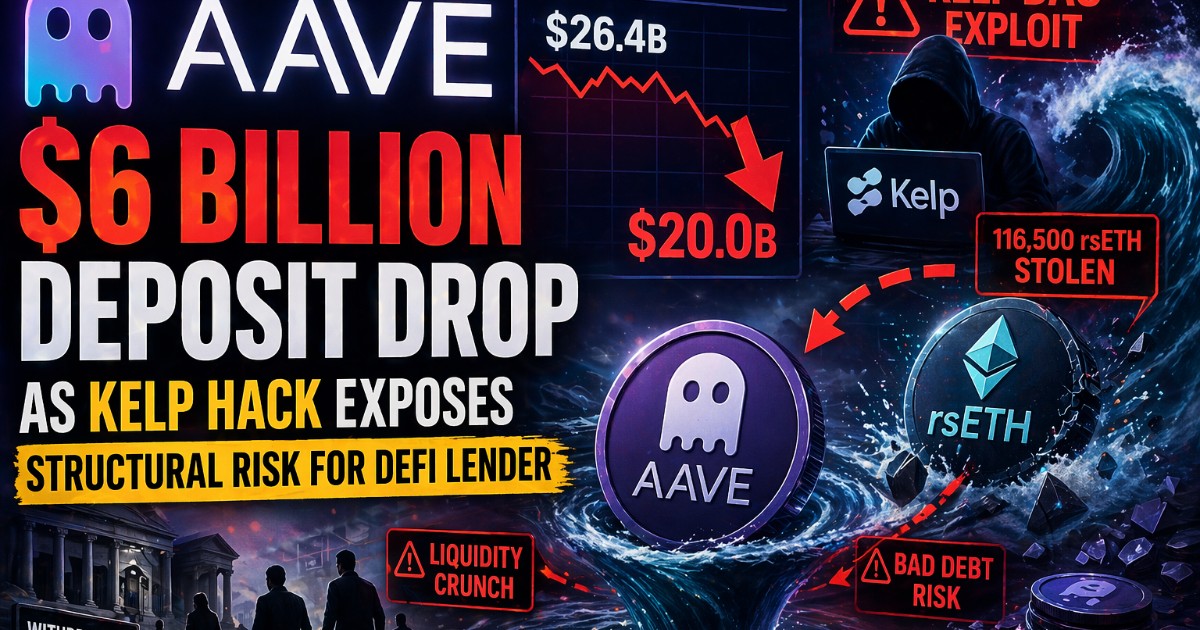
Aave’s total value locked fell from about $26.4 billion on April 18 to nearly $20 billion in U.S. morning trading on April 20, a drop of roughly $6 billion in the initial wave of withdrawals. CoinDesk linked the decline directly to fallout from the Kelp DAO exploit and the fear that Aave was left holding major bad debt.
That selloff did not happen because Aave itself was hacked. It happened because users realized the protocol was now exposed to losses created somewhere else in the DeFi stack.
The structural problem came from using stolen rsETH as collateral
The exploit began when attackers drained 116,500 rsETH from Kelp DAO’s bridge, an incident reported at roughly $290 million to $293 million in value. According to CoinDesk and other coverage, the attacker then deposited a large amount of that rsETH into Aave V3 as collateral and borrowed real ETH and related assets against it.
That is the key structural risk. Aave did not create the bad asset, but its lending design still allowed the asset to be posted as collateral before the market fully priced in the damage. Once that happened, Aave became the place where losses could crystallize.
Aave could be left with large bad debt
CoinDesk reported that Aave could face between about $123 million and $230 million in losses, citing analysis from Aave Labs and LlamaRisk. Other reporting put the potential bad debt range at roughly $177 million to $236 million, depending on assumptions around recovery and collateral value.
That range matters because it shows this is not just a temporary market scare. Depositors are reacting to the possibility that Aave may be forced to absorb losses from collateral that no longer has credible backing.
The exploit also triggered a liquidity crunch
The market reaction was not limited to headline TVL declines. Reports said Aave’s ETH pool hit 100% utilization as users rushed to withdraw while the attacker borrowed aggressively against the compromised rsETH collateral. CoinDesk also reported a spike in daily fees and heavy liquidations over the weekend.
That made the problem visible in real time. Depositors were not just worried in theory, they were dealing with strained liquidity conditions inside the protocol itself.
Why this matters for the market
This matters because it shows how DeFi lending protocols can inherit risk from assets they do not issue and bridges they do not control. Aave was not hacked directly, yet it still became one of the biggest casualties of the Kelp incident because it sat downstream from the exploit.
It also shows that “composable” DeFi can transmit damage very fast. A failure in a bridge or liquid restaking token can quickly become a solvency and liquidity problem for a lending venue that accepted that asset as collateral. That last point is an inference from the exploit chain and the reported deposit flight.
The bigger lesson is that DeFi risk is still highly contagious
The clean takeaway is that Aave’s $6 billion deposit drop was not just a panic move. It was the market reacting to a real structural weakness in DeFi, where one compromised asset can spread stress across multiple protocols almost instantly. The Kelp exploit did not just break a bridge. It showed how quickly trust can leave a lender when collateral quality becomes uncertain.
Explore more articles like this
Subscribe to Asvoria News to receive all the latest news.
Stay ahead with exclusive press releases and expert insights on Web3 and the Spatial Web. Be the first to hear about Asvoria’s latest innovations, events, and updates. Join us — subscribe today!
Editor’s choice
- S and P Introduces Digital Markets 50 Index Blending Crypto and Stocks
- Tensions Between U.S. Senators Stall Crypto Regulation Bill
- BlackRock’s iBIT ETF Hits 100 Billion Dollars in Assets Amid Institutional Crypto Surge
- Major Global Banks Explore Issuing Stablecoins Pegged to G7 Currencies
- Crypto Carnage: $102K Bitcoin Flash Crash and SUI’s 87% Plunge as Tariff Shock Triggers Record Liquidations
© 2026 Asvoria. All rights reserved.
Avoria does not endorse or promote investment in any of the tokens or NFT projects featured on this platform.
We accept no responsibility for any losses incurred. Users should conduct their own research and consult with a financial advisor before investing.
For more information about Doing Your Own Research (DYOR), please visit this link.