
We Value Your Privacy
We use cookies and similar technologies to enhance your browsing experience, analyze site traffic, and personalize content. By clicking “Accept All,” you consent to the use of all cookies. You can manage your preferences or learn more by clicking “Settings.”For detailed information, please review ourPrivacy Policy.

'%3e%3cpath%20d='M4.54459%200H19.8998C20.9954%200.0908297%2022.0949%200.79476%2022.6038%201.81951C22.935%202.48559%2023.2135%203.85095%2022.7719%204.49782C22.3516%205.11383%2021.3983%205.11325%2020.9786%204.49782C20.514%203.81718%2021.2257%202.69229%2019.8438%202.29985H4.68469C2.89811%202.623%202.62631%204.98049%204.46053%205.5313H19.9278C21.6814%205.76536%2022.8761%207.05269%2022.9961%208.89374V17.2198C22.8711%2018.7884%2021.8024%2019.8841%2020.2921%2020H5.30114C2.99338%2019.8556%201.30823%2018.2253%201%2015.8515V3.50801C1.27684%201.55109%202.64424%200.177584%204.54459%200ZM3.19961%207.51092C3.19512%2010.1846%203.19008%2012.8576%203.1856%2015.5313C3.32626%2016.7627%204.12652%2017.6064%205.32916%2017.7001H20.2361C21.0733%2017.6274%2020.7152%2016.4512%2020.7684%2015.8079C19.7395%2015.6879%2017.3068%2015.8696%2016.5654%2015.7787C16.3877%2015.7304%2016.2106%2015.6815%2016.033%2015.6332C14.9514%2015.2402%2014.2862%2014.1234%2014.2257%2012.9694C14.1775%2012.0541%2014.2795%2011.1953%2014.8421%2010.4658C15.2165%209.9802%2015.9136%209.52838%2016.5093%209.43231C17.2356%209.31528%2020.4793%209.4818%2020.7124%209.4032C20.7359%209.38865%2020.7589%209.37409%2020.7825%209.35953C20.8452%208.59098%2020.5773%207.99418%2019.8158%207.83115H4.51657C4.05535%207.79971%203.63673%207.64425%203.19961%207.51092ZM16.8736%2011.7031C16.2807%2011.809%2016.4639%2012.6457%2016.4393%2013.0859C16.5172%2013.2606%2016.6847%2013.4713%2016.8736%2013.508H20.7404L20.7825%2013.4643V11.7467L20.7404%2011.7031H16.8736Z'%20fill='%23A2A2A2'/%3e%3c/g%3e%3cdefs%3e%3cclipPath%20id='clip0_2228_119675'%3e%3crect%20width='22'%20height='20'%20fill='white'%20transform='translate(1)'/%3e%3c/clipPath%3e%3c/defs%3e%3c/svg%3e)
Not connected

Build with Asvoria.app — Launch Smarter, Faster!
Instantly create stunning AI-powered web apps and games for your next big project on Asvoria.app. No coding. No waiting. Just launch.
Bitcoin Mining Difficulty Sees Sharpest Drop Since 2021 as Miners Capitulate
February 10, 2026 at 9:07 AMby The Block Whisperer

+17

+0
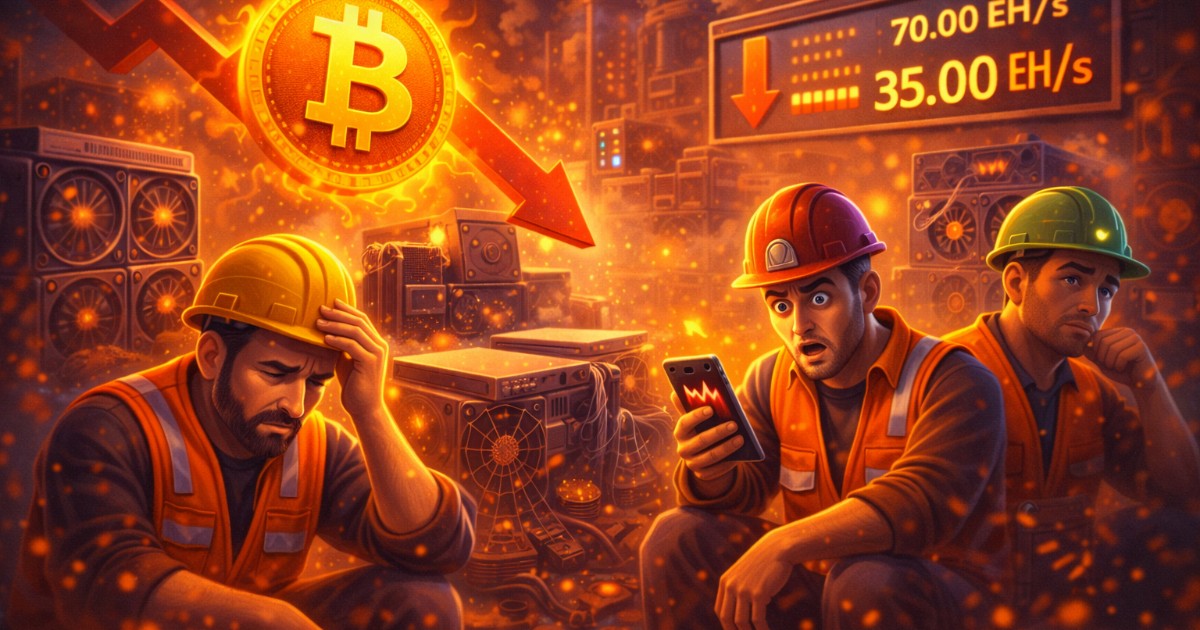
Bitcoin mining difficulty has fallen by its largest margin since 2021 as falling revenues force weaker miners to shut down machines or exit the market entirely.
Web3 insights in your social media feed
A rare and significant difficulty adjustment
Bitcoin’s mining difficulty has recorded its steepest downward adjustment in several years. Such moves are uncommon and usually signal stress across the mining sector.
Difficulty adjusts automatically to keep block production stable, rising when more computing power joins the network and falling when miners disconnect. A sharp drop means a meaningful portion of hash power has gone offline.
This latest adjustment reflects growing pressure on miners following months of declining profitability.
Revenue pressure drives miner capitulation
At the heart of the problem is revenue.
Bitcoin revenue per petahash has fallen sharply, dropping from roughly $70 at its recent peak to about $35. That represents a cut of around fifty percent in a relatively short period.
For miners operating with high energy costs, older hardware, or thin balance sheets, this level of revenue is no longer sustainable. As margins compress, operators are forced to make difficult choices, including powering down rigs or selling equipment.
This process is often referred to as miner capitulation.
Why weaker miners are hit first
Mining is a scale-driven business.
Large operators with access to cheap electricity, efficient hardware, and strong balance sheets can survive extended downturns. Smaller or highly leveraged miners do not have the same flexibility.
As bitcoin prices softened and network competition remained intense, the least efficient players were pushed out first. Their exit reduced total network hash rate, triggering the difficulty drop.
This is how the network self-corrects during periods of stress.
What lower difficulty means for remaining miners
For miners that stay online, a lower difficulty offers some relief.
With fewer competitors, the remaining hash power earns a larger share of block rewards. That can slightly improve profitability, assuming bitcoin prices and transaction fees remain stable.
However, the benefit is often gradual. If prices continue to struggle, even efficient miners may remain under pressure despite the reduced difficulty.
A familiar cycle in bitcoin mining
This pattern is not new.
Previous market downturns have produced similar cycles where falling prices squeeze margins, miners capitulate, and difficulty resets lower. Over time, stronger operators consolidate their position while weaker ones disappear.
Historically, these moments have marked periods of stress but also long-term resilience for the network.
What to watch next
The key question is whether this adjustment marks the worst of the pressure or just a pause.
Market participants will be watching:
- whether bitcoin prices stabilize or fall further
- if additional miners disconnect in coming weeks
- how quickly difficulty adjusts again
Sustained weakness could lead to further capitulation, while price recovery would ease pressure across the sector.
A stress test for the mining industry
This difficulty drop serves as a stress test for the bitcoin mining ecosystem.
It highlights how sensitive miners are to price, energy costs, and competition. At the same time, it demonstrates the network’s ability to adapt automatically when conditions change.
For bitcoin itself, the system continues to function as designed, even under strain.
Explore more articles like this
Subscribe to Asvoria News to receive all the latest news.
Stay ahead with exclusive press releases and expert insights on Web3 and the Spatial Web. Be the first to hear about Asvoria’s latest innovations, events, and updates. Join us — subscribe today!
Editor’s choice
- Major Global Banks Explore Issuing Stablecoins Pegged to G7 Currencies
- Crypto Carnage: $102K Bitcoin Flash Crash and SUI’s 87% Plunge as Tariff Shock Triggers Record Liquidations
- S and P Introduces Digital Markets 50 Index Blending Crypto and Stocks
- Tensions Between U.S. Senators Stall Crypto Regulation Bill
- BlackRock’s iBIT ETF Hits 100 Billion Dollars in Assets Amid Institutional Crypto Surge
© 2026 Asvoria. All rights reserved.
Avoria does not endorse or promote investment in any of the tokens or NFT projects featured on this platform.
We accept no responsibility for any losses incurred. Users should conduct their own research and consult with a financial advisor before investing.
For more information about Doing Your Own Research (DYOR), please visit this link.