We Value Your Privacy
We use cookies and similar technologies to enhance your browsing experience, analyze site traffic, and personalize content. By clicking “Accept All,” you consent to the use of all cookies. You can manage your preferences or learn more by clicking “Settings.”For detailed information, please review ourPrivacy Policy.

'%3e%3cpath%20d='M4.54459%200H19.8998C20.9954%200.0908297%2022.0949%200.79476%2022.6038%201.81951C22.935%202.48559%2023.2135%203.85095%2022.7719%204.49782C22.3516%205.11383%2021.3983%205.11325%2020.9786%204.49782C20.514%203.81718%2021.2257%202.69229%2019.8438%202.29985H4.68469C2.89811%202.623%202.62631%204.98049%204.46053%205.5313H19.9278C21.6814%205.76536%2022.8761%207.05269%2022.9961%208.89374V17.2198C22.8711%2018.7884%2021.8024%2019.8841%2020.2921%2020H5.30114C2.99338%2019.8556%201.30823%2018.2253%201%2015.8515V3.50801C1.27684%201.55109%202.64424%200.177584%204.54459%200ZM3.19961%207.51092C3.19512%2010.1846%203.19008%2012.8576%203.1856%2015.5313C3.32626%2016.7627%204.12652%2017.6064%205.32916%2017.7001H20.2361C21.0733%2017.6274%2020.7152%2016.4512%2020.7684%2015.8079C19.7395%2015.6879%2017.3068%2015.8696%2016.5654%2015.7787C16.3877%2015.7304%2016.2106%2015.6815%2016.033%2015.6332C14.9514%2015.2402%2014.2862%2014.1234%2014.2257%2012.9694C14.1775%2012.0541%2014.2795%2011.1953%2014.8421%2010.4658C15.2165%209.9802%2015.9136%209.52838%2016.5093%209.43231C17.2356%209.31528%2020.4793%209.4818%2020.7124%209.4032C20.7359%209.38865%2020.7589%209.37409%2020.7825%209.35953C20.8452%208.59098%2020.5773%207.99418%2019.8158%207.83115H4.51657C4.05535%207.79971%203.63673%207.64425%203.19961%207.51092ZM16.8736%2011.7031C16.2807%2011.809%2016.4639%2012.6457%2016.4393%2013.0859C16.5172%2013.2606%2016.6847%2013.4713%2016.8736%2013.508H20.7404L20.7825%2013.4643V11.7467L20.7404%2011.7031H16.8736Z'%20fill='%23A2A2A2'/%3e%3c/g%3e%3cdefs%3e%3cclipPath%20id='clip0_2228_119675'%3e%3crect%20width='22'%20height='20'%20fill='white'%20transform='translate(1)'/%3e%3c/clipPath%3e%3c/defs%3e%3c/svg%3e)
Not connected

Build with Asvoria.app — Launch Smarter, Faster!
Instantly create stunning AI-powered web apps and games for your next big project on Asvoria.app. No coding. No waiting. Just launch.
Lido’s New stVaults Let Layer-2s and Institutions Set Their Own Rules for Ethereum Staking
January 30, 2026 at 12:11 PMby The Block Whisperer

+14

+0
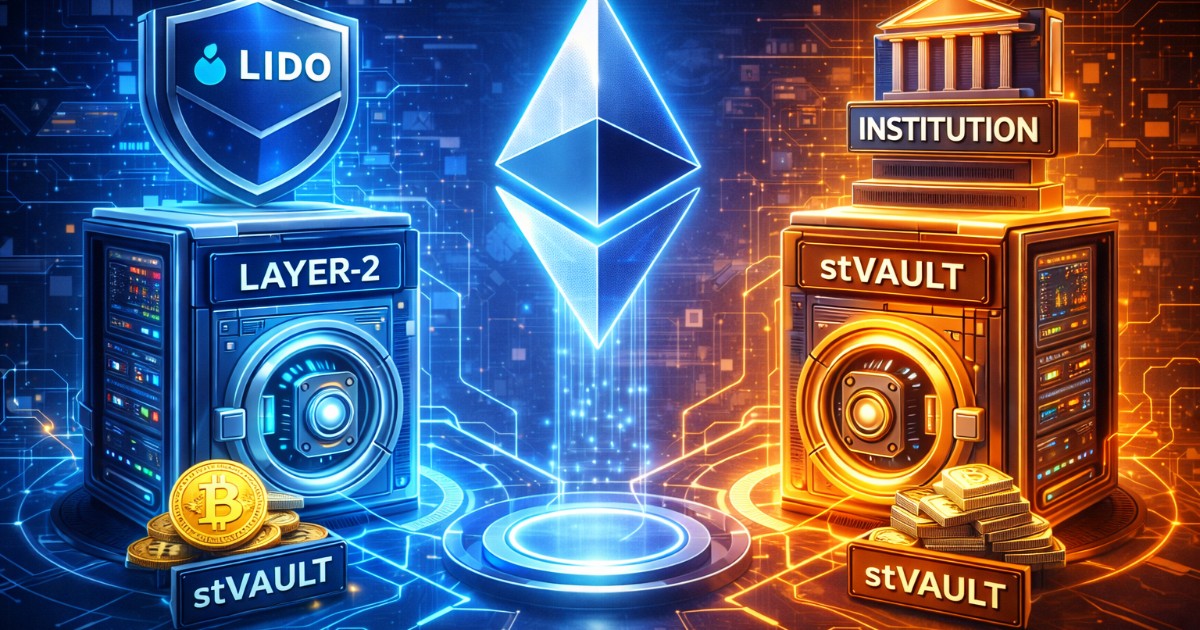
Lido has introduced stVaults, a new staking framework that allows other teams to build custom Ethereum staking products without creating their own infrastructure from scratch.
Web3 insights in your social media feed
A shift away from one-size-fits-all staking
Ethereum staking has largely operated on a pooled model. Users deposit ETH, validators are selected by the protocol, and rewards are distributed under a shared rule set. This approach simplified staking but limited flexibility.
Lido’s new stVaults change that model.
Instead of forcing every participant into the same pool, stVaults allow external teams to define how staking works for their own use cases while still relying on Lido’s core infrastructure.
This marks a move toward modular staking rather than a single global configuration.
What stVaults actually are
stVaults are customizable staking environments built on top of Lido’s staking system. They allow projects to plug into Lido’s validator and liquidity framework while defining their own rules.
Teams can control elements such as:
- validator selection and operator requirements
- reward distribution logic
- fee structures
- governance and policy constraints
Despite this customization, vaults can still interact with the broader Ethereum ecosystem through liquid staking mechanics.
Why this matters for layer-2 networks
Layer-2 networks increasingly want staking to serve their own ecosystem goals. That might include directing rewards toward network incentives, aligning validator behavior with rollup security assumptions, or integrating staking more tightly with bridging and sequencing.
Previously, doing this required building and maintaining a full staking stack.
With stVaults, an L2 can define its staking logic and deploy it on top of an existing, battle-tested system. This reduces engineering effort, shortens time to market, and avoids fragmenting liquidity.
Lower friction for builders and institutions
Beyond L2s, stVaults also appeal to institutions and infrastructure providers.
Building a staking product from scratch involves smart contracts, validator management, security audits, liquidity bootstrapping, and long-term maintenance. stVaults remove much of that overhead.
Teams can focus on policy and product design rather than plumbing. That makes it easier to experiment with staking models that emphasize compliance, risk control, or yield optimization.
Liquidity without fragmentation
One of the biggest challenges in Ethereum staking is liquidity fragmentation. When every protocol launches its own staking token, liquidity spreads thin and composability suffers.
stVaults aim to avoid that outcome.
Custom staking logic can coexist while still benefiting from shared liquidity and existing DeFi integrations. This preserves composability while allowing specialization.
It is a middle ground between fully pooled staking and fully isolated staking systems.
What this signals for Ethereum staking
stVaults reflect a broader trend in Ethereum infrastructure. Core protocols are becoming modular platforms rather than monolithic systems.
Instead of dictating a single way to stake, Lido is positioning itself as a base layer that others can build on. That approach mirrors what has already happened in DeFi, rollups, and application development.
If widely adopted, stVaults could reshape how staking products are designed, especially for networks and institutions that need more control without sacrificing security or liquidity.
Explore more articles like this
Subscribe to Asvoria News to receive all the latest news.
Stay ahead with exclusive press releases and expert insights on Web3 and the Spatial Web. Be the first to hear about Asvoria’s latest innovations, events, and updates. Join us — subscribe today!
Editor’s choice
- Crypto Carnage: $102K Bitcoin Flash Crash and SUI’s 87% Plunge as Tariff Shock Triggers Record Liquidations
- S and P Introduces Digital Markets 50 Index Blending Crypto and Stocks
- Major Global Banks Explore Issuing Stablecoins Pegged to G7 Currencies
- BlackRock’s iBIT ETF Hits 100 Billion Dollars in Assets Amid Institutional Crypto Surge
- Tensions Between U.S. Senators Stall Crypto Regulation Bill
© 2026 Asvoria. All rights reserved.
Avoria does not endorse or promote investment in any of the tokens or NFT projects featured on this platform.
We accept no responsibility for any losses incurred. Users should conduct their own research and consult with a financial advisor before investing.
For more information about Doing Your Own Research (DYOR), please visit this link.